Sunday, July 15, 2007

Chaim Soutine 1894-1944

It is not often when I make a connection, but when I do it is a strong force - like being shot from a canon and reaching another destination. The experience is powerful, and a bit overwhelming.

For instance, when I breathe in the smell of the ocean, a warm rush of childhood memories spent on Cape Cod enters my mind, or when I see the color turquoise I am swimming in the crystal clear water of St. John, in the U.S. Virgin Islands. The smell of fresh cut grass brings me to the rolling hills of Kentucky, and the smell of hay delivers me to Shamrock, Texas where the air is fresh and clean, and the only thing that surrounds me is wide open space. When the aroma of coffee fills the air, I am six years old standing on the tips of my toes at the A&P watching the machine grind the coffee beans, while my mom reminds me not to stand too close. I viewed many forms of art at The Met, and I was getting discouraged because I was not able to connect with what I was seeing until I came across Chaim Soutine’s French, born Lithuania, 1893-1943, Little Girl with a Doll, ca. 1919, Oil on canvas.

My initial reaction which I voiced to the stranger standing next to me was what was going on in this little girl’s life that she appeared so distraught? He just looked at me dumbfounded.

I walked within a few inches of the painting, and couldn’t help but notice the little girl’s charcoal, hollow eyes – they were filled with such sadness and despair. Clearly, the painting was of a little girl, she looked impish, although her face portrayed that of an elderly, exhausted woman. I began taking photos, and looked forward to researching the artist Chaim Soutine.

Chaim Soutine was an expressionist painter who was not happy with his works or his life. He did not believe he had talent. He portrayed his own violent emotions in his work using vivid colors and distorted images. His artistic style was mixed with Fauvism and Cubism. This explained what I clearly indicated in his painting A Little Girl with a Doll.

Chaim Soutine was born in Russia near Minsk, Belarus, to an observant Jewish household. He rebelled against his traditional background, and enrolled in classes at the Academy of Fine Arts in Vilnus, Lithuania. A local art patron who admired Chaim’s work sent him to Paris in 1913 where he enrolled at the Ecole des Beaux Arts and worked under Fernand Cormon.

In 1919 Chaim spent time in the town of Ceret, in the Pyrennes Mountains, and began painting landscapes with apocalyptic themes. In Paris he began painting portraits of figures, his favorites being maids, and valets, with a more expressive style. He socialized with great painters such as Jules Pascin, Marc Chagall, and Amedeo Mogdialiani. He roomed with Mogdialiani and was severely distraught when he died in 1920.

Soutine was prone to violent rages, bouts of depression and had attempted suicide. He often destroyed his own works. He was known for his bizarre behaviors; once, he kept an animal carcass in his apartment for his painting Carcass of Beef. Despite his rages and eccentricities, he managed to sell many of his works to Dr. Alfred Barnes an American Collector who helped Soutine’s work find a large audience in the United States.

Many believed Soutine’s best exhibition of his works was in Paris, 1937. Several months after his showing in Paris, France fell under the hands of the Nazis. Soutine fled on foot for his life. He hid and slept in forests while he ate leaves, grass and berries to maintain his strength. Two weeks before the French liberation on August 8, 1944, he died due to complications from surgery on a stomach ulcer.

Sad, and distraught...


Her eyes the color of charcoal, empty and lifeless...
The artist clearly displays his own pain through his subject

The doll she is holding is morbid too...

The image of the little girl's face is distorted
and acts as a mirror for Soutine's own life...
Did this girl exist, or was it a figment of Chaim Soutine's imagination?
And if she did exist, what was her name?


Chaim Soutine, I hope you
and The Little Girl with a Doll
have found peace...

Sunday, July 8, 2007

My last paper will be posted the week of July 9th and it will feature the work of Chaim Soutine. French, born Lithuania, 1893-1943.
On the sixth day of July, I set sails for The MET.


"Set sails" does have a nice tone, but the reality was I departed from the New Haven train station, destination Grand Central, and rode the subway to 86th Street. With a bottled water in hand, and a new pair of Converse sneakers, I walked three blocks to the museum.

My plan was to tour the museum on a weekday rather than a weekend because I thought there would be less people. When I saw the crowds of people, I quickly remembered it was a holiday week. The security guards searched my bag, I purchased a ticket from a young girl who had a lovely smile, - and I was off.

Welcome to The Met!!! Please come with me and you will see some extraordinary art work.


This is The Museum Experience Course, but prior to taking your photography course, I doubt I would have even noticed - but when I saw the light I could hear your voice "it's all about the light."


Fragment of a literary tablet:
beginning and end of "Atrahasis," the Babylonian myth of the great flood

Clay - Mesopotamia, Babylon - Neo-Babylonian period, 7th - 6th century B. C.

The poem "Atrahasis," named after its hero, is an ancient Near Eastern precursor to the biblical story of Noah's ark. The text describes the creation of humankind and a great flood sent down by the god Enlil to destroy the people, who disturbed the gods with their noise. Atrahasis survived the flood by building a large boat.

Now this is History - pretty amazing!!! - See the writing on the tablet.

Bronze rod tripod
Cypriot, Late Bronze Age, ca. 1250-1050 B.C.

From Cyprus - represents some of the finest metal work produced in the eastern Mediterranean at the end of the Late Bronze Age. The decoration is a blend of Mycenaean Greek and Near Eastern elements.

It is hard for me to comprehend that work of this caliber existed during this period.
Henri Matisse (French, 1869-1954) Seated Woman, Back Turned to the Open Window,
ca. 1922, Oil on canvas

Notice the dialgoue between the interior and exterior space, the lively paisley pattern set the stage for the sailboats at sea.
Limestone Geryon
Cypriot, Archaic, 2nd half of the 6th century B.C.

In Greek mythology, Geryon was a three-bodied creature who lived in the West with his dog, a herd of cattle, and a herdsman.

Said to be at the temple at Golgoi...I couldn't tell what this was until I got closer and saw the baby's foot hanging out of the hammock.
Gabriel Orozco Mexican, born 1962
Nina en Homaca (Baby in Hammock), 1999
Silver dye bleach print

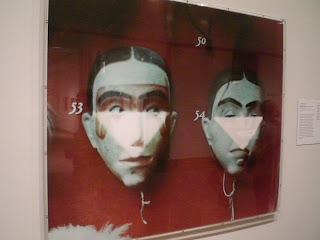
A sleeping beauty...Lothar Baumgarten, German, born 1944
Haida Metamorphosis, 1969
Chromogenic print

The artist used pocket mirrors to create the triangular reflections that hover before the objects, though the shapes partially obscure the masks. It is intriguing, and a bit creepy.

Florine Stettheimer, American, 1871-1944

The Cathedrals of Fifth Avenue, 1931-Oil on canvas
Fifth Avenue - New York's shopping mecca

Darling I love you but give me Park Avenue...
Stuart Davis, American, 1892-1984
Percolator
1927-Oil on canvas

This painting was really neat because it deconstructs the rounded, cylindrical forms of an ordinary coffeepot into the Cubist language of flat, overlapping planes and wedges. It was the first time Davis used what he called "color-space" logic - placing colors in such a way as to suggest spatial relationships. Pablo Picasso, Spanish, 1881-1973
Cavalier and a Seated Nude
1967 - Oil on canvas
Sofa, design - Filippo Pelagio Palagi (1775-1860)
Made by Gabriele Capello (1806-1876)

For the King of Sardinia, Carlo Alberto (1798-1849)

Upon viewing the color, fabric, and pattern of the sofa, I knew the owners were royalty. The mahogany and maple is so luxurious!

Brise Fan
Pierced and painted ivory; silk ribbon, metal loop, French, 1830

The fan is delicate, elegant, and feminine. It would compliment any woman's wardrobe. My stomach was empty so I ate lunch in the museum dining gallery. The menu was pricey but the salmon was delicious! During lunch I watched through the glass windows of the museum a homeless man dance, and speak to himself outside on the grass, while the couple sitting next to me laughed, he was their entertainment.
I began to wonder what his story was. Was he a father, or someone's brother? Was he once successful, did he ever eat lunch where I sat? Did he have addiction problems or was he mentally ill? Did he ever experience the joy of seeing the wonders that exist at The Met? One never knows one's own fate.

As I walked to the subway, I humbly thanked my higher power for the precious gift I have been given - my life...

Thursday, June 28, 2007

Paper Three (3) Surrealism/Dorothea Tanning

The Yale Art Gallery was not one that I fancied unlike the Wadsworth which was a delightful surprise. I was about to exit the gallery when I saw the piece Reve (Dream) 1944, Dorothea Tanning, American, born 1910, Oil on canvas. It was unusual and amusing. My research led me to discover that Dorothea Tanning is one of the last living members of the Surrealist Movement. Andre Breton, a French poet launched the Surrealist Movement with the publication of his Manifesto of Surrealism, in Paris in 1924. Breton was influenced by the theories of Sigmund Freud, the founder of psychoanalysis.

Freud identified a deep layer of the human mind where memories and our most basic instincts are stored. He called this the unconscious, since most of the time we are not aware of it. The aim of Surrealism was to reveal the unconscious and reconcile it with rational life. The Surrealists did this in literature as well as art.

Surrealism also aimed at social and political revolution and for a time was affiliated to the Communist party. There was no single style of Surrealist art but two broad types are the oneiric (dream-like) work, and the automatism. Freud believed that dreams revealed the workings of the unconscious, and his famous book The Interpretation of Dreams was central to Surrealism. Automatism was the Surrealist term for Freud's technique of free association, which he also used to reveal the unconscious mind of his patients. Surrealism had a huge influence on art, literature and the cinema as well as on social attitudes and behavior.

Dorothea was the fourth wife to Max Ernst (known to many as “one of the gods”) to Surrealism. Tanning was born in Galesburg, Illinois, August 25, 1910, where she worked as a librarian. In 1930 she briefly studied at the Academy of Fine Art in Chicago, and moved to New York City where she spent her time studying art in galleries and museums.

Dorothea lived in Paris for several years and met Max Ernst (when he was married to Peggy Guggenheim) at the Julien Levy Gallery in New York where many of the Surrealists were exiled during World War II. Dorothea and Max married in 1946. Through her husband she became acquainted with the Surrealists world.

Although she married Max his work had no perceivable influence on her. Dorothea's subjects were mainly figures, interior views, and still life; the mediums oil and watercolor.

Tannings earlier surrealist evocations consisted of perverse children's games and fantasies to experiments with different paintings, and later sculptural approaches. In the late 1930's she painted young women and their sexual fears and fantasies in a hyper-realistic way. Beginning in the 1950's, however, her work became more abstract with sexual and violent images not quite clearly discernable; her involvement with symbolic and dream material has remained constant.

Despite the well-known photograph of Tanning and Ernst in Arizona, they spent much of their time in France from the late 1940s until his death. She is consequently much better known in Europe than in the U.S., though she is finally beginning to be as well known in her native country as in her adopted one.

Dorothea Tanning had her first one-woman exhibition at the Julien Levy Gallery in 1944.

Dorothea Tanning
American, born 1910
Reve (Dream)
1944 - Oil on canvas

Mini purses in a shell...
Notice how some purses are open while are others shut

Some purses contain money while others are empty


Some purses have smoke coming out of them while others have fire
And the one purse outside of the shell


contains something other than money...

Are those pebbles?


And if you look closely there is one that is not a purse, but an outline of a purse.
Unique best describes Dorothea Tanning.

Sunday, June 24, 2007

Paper Number Two (2)

One of the advantages of working at a college is the summer hours so this past Friday I spent the day at the Wadsworth Atheneum Museum of Art in Hartford, CT. I had no idea a museum of this caliber existed in Hartford never mind the fact that it is the home to nearly 50,000 works of art spanning 5,000 years. The collections include Renaissance and Baroque paintings, Mediterranean antiques, seventeenth-century American furniture and decorative arts, textiles and costumes, Meissen porcelain, African-American art and artifacts, American landscapes, European and American impressionist paintings, and modern and contemporary art.

The current exhibitions on view are the Connecticut Contemporary which features over 100 works by local, talented artists, Picasso to Pop: Aspects of Modern Art, Faith and Fortune: Five Centuries of European Masterworks, and For the Love of the Game, Race and Sport in America.

I was about to enter a section of the museum when from the corner of my eye I saw this luminescent color of blue, and knew instantly it was the work of Maxfield Parrish. As a young girl Ansel Adams and Maxfield Parrish were my introduction to the art world. Maxfield Parrish was one of America’s most beloved artists who worked during the “Golden Age of American Illustration". He was known to many Americans as the common man’s Rembrandt.

During his lifetime he achieved artistic renowned critical acclaim, and continues to hold the attention of audiences today. His work has been reproduced in calendars, books, advertisements, art prints, and magazines. Maxfield's murals and paintings utilized a unique juxtaposition of designed elements, luminescent colors, photorealistic subjects and romantic images of far-away, fantasy places. In the 1920’s Maxfield Parrish was so popular with the American people one out of four homes had his work hanging on their wall. Even today there is a high demand for his art prints which indicates America’s fondness for his work.

At Haverford College he studied architecture, and then dropped out to study painting. While living with his dad in Gloucester, Massachusetts he painted his first serious work, 'Moonrise', and simultaneously enrolled at the Pennsylvania Academy of Fine Art. At the Academy he became interested with the work of Howard Pyle and audited Pyle's first classes in illustration. Parrish realized that the use of historic subject matter captured the sentiments of the print audience.

Parrish attended a class at Yale where Jay Hambidge, a historian-illustrator lectured on a composition called “dynamic symmetry”– this system offered a formula for reproducing natural proportions in their works. This symmetry later became a major part of his art. In fact, all of his works are based around this technique. First, he did montage layouts which he would then paint. The final execution was almost etching-like, precisely articulated with romantic images of far-away fantasy places. The colors that appear in Parrish's works are so bold even today cobalt blue is referred to as "Parrish blue.”


Maxfield Parrish
American, 1870-1966
Study for Old Glen Mill, c. 1932 The colors are brillantly bright!

A peaceful place far-away... Serentiy...
Magical...

Wonderous...
A place to just be... Elegant...

Maxfield Parrish, there's only one... Thank you for joining me on this magical journey, until we meet again, I wish you peace...

Wadsworth Atheneum Museum of Art

Hello, and welcome to the Wadsworth Antheneum Museum of Art, located in Hartford, CT. Please follow me, and you will see a collection of wonderful treasures...
I took seventy five (75) photos - here are a few for you...

Tray, English, 1662 - Silk, satin-weave foundation over iron wire; embroidery in silk, raised work technique; glass beadwork; silk ribbons The Costume and Textile Purchase Fund
Crucifixion, French, 16th century, Leonard Limousin, I. c. 1505-1575/1577, Enamel on copper

Such vibrant colors!!!
Daniel Maclise, Irish, 1806-1870, The Disenchantment of Bottom, 1832, Oil on canvas

"Fairy Painting" was a category of painting in 19th century England, and this was one of the earliest works in the genre.

Georgia O'Keeffe, American, 1887-1986, The Lawrence Tree, 1929, Oil on canvas

Georgia's career was launched in New York by Alfred Stieglitz, the photographer who she eventually married.
Childe Hassam, American, 1859-1935, Nymph of the Siren's Grotto, 1909, Oil on canvas Paul Gauguin, French, 1843-1903, Nirvana: Portrait of Meyer de Haan, c. 1889-1890, Oil and turpentine on silk

Meyer de Haan was a Dutch artist and one of the leading spokesmen of the Synthesist movement whose goals were the simplification of visual experience and an emphasis on symbolic content in painting.
Henri de Toulouse - Lautrec, French, 1864-1901, Jane Avril Leaving the Moulin Rouge, 1892, Gouache on board - Jane Avril star attraction, but off stage she is shown thoughtful and isolated, a melancholy figure.
Bath Tub - Roman, 100 B.C. - 100 A.D. Red Egyptian Porphyry Giovanni Domenico Tiepolo, Italian, Venetian, 1727-1804, The Building of the Trojan Horse, c. 1773-74, Oil on canvas


A classic... Michelangelo Merisi da Caravaggio, Italian, Roman school, 1571-1610, Saint Francis of Assisi in Ecstasy, c. 1594, Oil on canvas

St. Francis of Assisi, founder of the Franciscan order, died in 1226, and was canonized just two years later. One of the miracles most commonly associated with his life is his assumption of the Stigmata, the wounds that Christ recieved during the Crucifixion.
The Cabinet - see description belowCabinet
Flemish, mid-17th century
Ebony, tortoise, shell, ivory, gilt metal

The Cabinet was decorated in the workshop of Frans Francken the Younger, (1581-1642). The double doors reveal scenes of Noah and the ark and the construction of the Tower of Babel, while the hinged lid is decorated with a scene of Cain killing Abel. Thomas W. Dewing, American, 1851-1938, The Days, 1884-1886, Oil on canvas

Soft, and elegant...
Theodore Robinson, American, 1852-189, Beacon Street, Boston, 1884, Oil on canvas

Diego Rivera Mexican, 1886-1957. Girl with a Mask, 1939, Oil on canvas I hope you enjoyed viewing the latest collections, and hope to see you again soon.
Susan

Paper Number One (1)

My family is from Massachusetts, and they reside within close proximity to Boston. Although I have lived in CT for a few years, I am a Bostonian - born and bred. Yes, I am biased, I believe Boston is a wonderful city. It has everything: history, culture, art, architecture, the marathon, sports teams (yes, the Red Sox), the Harbor, Aquarium, Science Museum, Quincy Market, Faneuil Hall, the Public Gardens, Newbury Street, Cambridge, the Charles, the Pops, and so much more. With its New England charm and European flair, “there’s no place like home.”

Boston has some of the best schools in the country: MIT, Wellesley, Smith, and Harvard (to name a few). The rivalry between Harvard and Yale continues so when my husband and I went to the Yale Center for British Art I wasn’t expecting much - to my surprise the exhibitions were great.

I was immediately drawn to John Frederick Lewis, 1805 – 1876, “And the prayer of faith shall save the sick” (Epistle of James, 5:15) oil on plywood panel, 1872, the colors in his painting were magnificent. Red, turquoise, orange, yellow, blue, violet and green - they were so vibrant they jumped out from the frame. I was also intrigued by the work of Frank Auerbach, born in 1931, oil on board, ca 1955. His portraits were of his friends, and their expressions were of utter despair and emptiness, his work is dark, disturbing, and hauntingly beautiful.

And then “it” happened. I was in awe of a painting by John Atkinson Grimshaw, 1836-1893, oil on canvas, ca. 1884 and the title: Evening Glow. I was mesmerized by the “light” in the painting. As I moved closer my eyes filled with tears, and I felt pure inner-peace, heavenly-like. I felt the presence of my mother, as though she was hugging me (she is deceased). My husband asked if I was alright, I answered yes, and proceeded to immerse myself in this painting.

Prior to becoming an aesthetic artist, John Atkinson Grimshaw worked as a railway clerk. In 1836 he was born in Leeds, and was the son of Arthur E. Grimshaw a policeman. His parents were opposed to his decision to make art his career. John was influenced by the Pre-Raphaelites, and he created vivid, highly finished landscapes. He slowly developed his own distinctive style, and subject matter. He became a consummate painter of twilight, night time, and autumnal scenes. John spent vacations in Scarborough, and many of his pictures were created there.

In the mid 1880’s he had a London Studio and painted nocturnal harbor and dockside pictures as well. His commercial success warranted him to purchase Knostrop Hall on the outskirts of the city. Rumor was he was a friend of Whistler. His paintings consisted of interiors, portraits, and fairy pictures, but his most accomplished pictures were of attractive sophisticated young women in opulent interiors.

In the early 1890s John’s style shifted in a new direction, showing Sand, Sea, Summer, and Fantasy of 1892, and At Anchor 1893. His formal style of painting was moving toward a freer, flowing, less informal style - perhaps influenced by Whistler. Unfortunately, this change of direction came to a halt when John Atkinson Grimshaw died of cancer in 1893.

My mother and I spent autumn afternoons (her favorite time of year) walking around Beacon Hill, sharing our lives with each other, as mothers and daughters often do. Ironic that she passed away on a warm, glowing autumn day.

John Atkinson Grimshaw and his painting Evening Glow reminded me of a precious gift, my mother's love.


Magical days,
and mystical ones...

Golden days...

and days to treasure...
Feel the warmth, of love around you
and embrace the life
you have been given.
Peace...